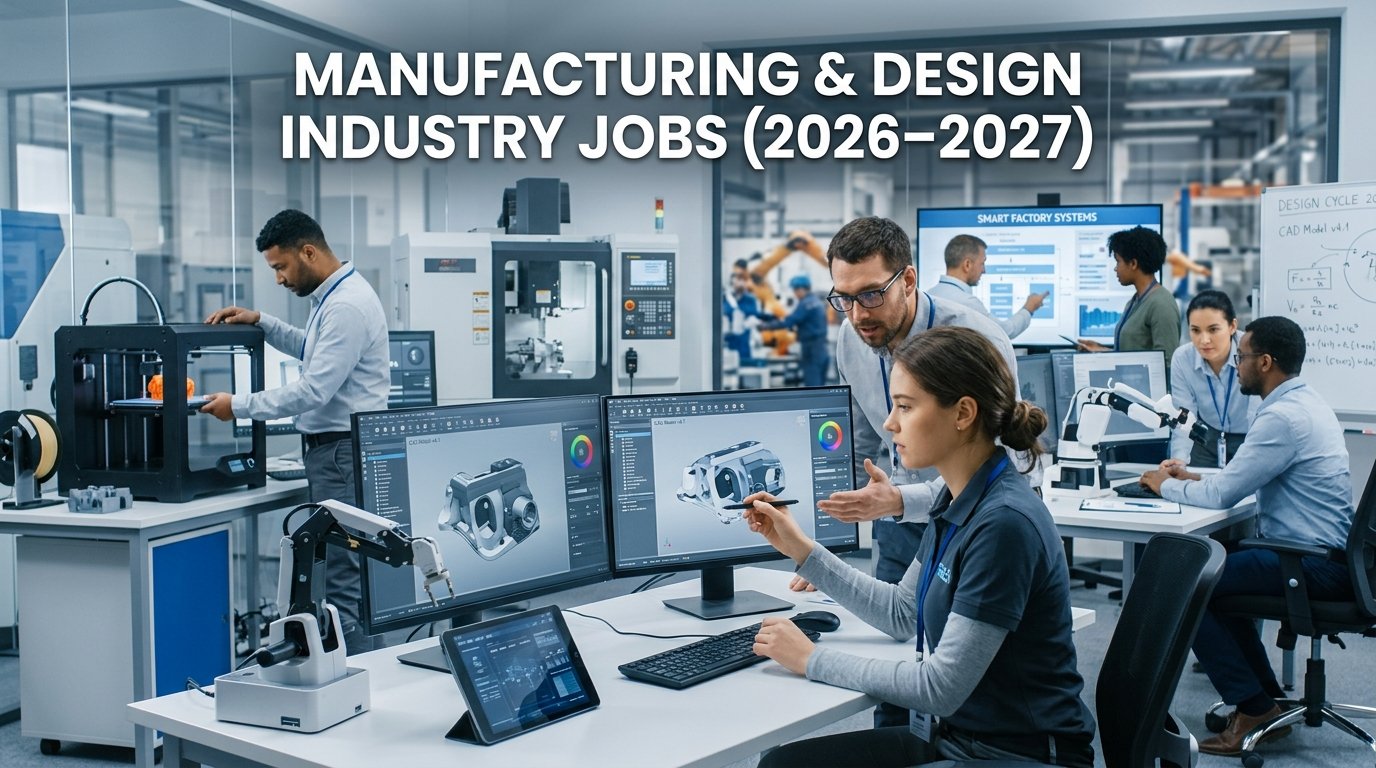
Complete Career & Hiring Outlook
The manufacturing and design sectors are undergoing a massive transformation heading into 2026 and 2027. Powered by rapid developments in automation, artificial intelligence (AI), sustainable materials, and smart factories, the job market for engineers, industrial designers, and technical specialists is booming.
Whether you are an experienced professional, a recent graduate, or someone looking to switch careers, understanding where the industry is heading—and which roles are in highest demand—will give you a significant competitive edge.
Key Drivers Shaping the 2026–2027 Job Market
Several core shifts are dictating hiring trends across the global manufacturing and product design ecosystems:
- Agentic AI & Physical Robotics: Traditional assembly lines have evolved into intelligent, connected ecosystems. Factories now rely heavily on autonomous systems, predictive maintenance, and spatial AI, creating a huge demand for tech-literate personnel.
- Sustainable & Circular Design: Companies are legally and commercially driven to reduce carbon footprints. As a result, sustainable material engineering and eco-friendly design are top priorities.
- Reshoring and Localized Production: Supply chain disruptions over recent years have forced major corporations to rebuild domestic manufacturing hubs, creating thousands of localized technical jobs.
- Skills-Based Hiring: Employers are increasingly prioritizing practical technical skills, CAD/CAM proficiency, and hands-on experience over traditional four-year degrees alone.
Top In-Demand Jobs in Manufacturing & Design (2026–2027)
Below are the key roles experiencing the highest growth, along with their primary responsibilities and expected salary ranges:
1. Automation & Robotics Engineer
As smart factories expand, companies require specialists to design, program, and maintain autonomous equipment and robotic systems.
- Core Skills: Python/C++, PLC Programming, ROS (Robot Operating System), Machine Learning, System Integration.
- Average Salary Range: $90,000 – $150,000+ per year.
2. Industrial & Product Designer
Modern product designers do more than make products look visually appealing; they integrate ergonomics, user experience (UX), 3D modeling, and sustainable manufacturing practices.
- Core Skills: CAD (SolidWorks, Fusion 360), Rapid Prototyping, DFMA (Design for Manufacture and Assembly), UI/UX integration.
- Average Salary Range: $75,000 – $125,000 per year.
3. Additive Manufacturing (3D Printing) Specialist
Industrial 3D printing is revolutionizing aerospace, automotive, and medical device manufacturing. Specialists in this domain manage complex metal and polymer 3D printing systems.
- Core Skills: Material Science, Generative Design, Topology Optimization, Post-Processing.
- Average Salary Range: $70,000 – $115,000 per year.
4. Quality Assurance & Reliability Engineer
With automated production moving faster than ever, maintaining product compliance and structural integrity is paramount.
- Core Skills: Six Sigma / Lean Manufacturing, ISO Standards, Automated Inspection Tools, Failure Analysis.
- Average Salary Range: $70,000 – $130,000 per year.
5. Smart Factory & IoT Process Engineer
These professionals oversee the integration of physical production hardware with digital cloud analytics to optimize efficiency, cut waste, and reduce downtime.
- Core Skills: Data Analytics, Industrial IoT, SCADA Systems, Process Optimization.
- Average Salary Range: $80,000 – $140,000 per year.
Key Skills Required to Get Hired
To stand out to recruiters during the 2026–2027 recruitment cycles, focus on building both hard technical abilities and cross-functional soft skills:
- Digital Literacy: Familiarity with Digital Twins, CAD/CAM platforms, and cloud-based industrial software.
- Agile Problem Solving: Ability to troubleshoot complex automated equipment quickly.
- Cross-Disciplinary Collaboration: Designers must understand manufacturing constraints, and production engineers must understand design intent.
How to Apply for Manufacturing & Design Openings
- Update Your Resume: Highlight practical projects, certification badges (e.g., Lean Six Sigma, SolidWorks, CAD), and measurable achievements.
- Build a Portfolio: For design and CAD roles, an online portfolio showcasing 3D models, prototypes, and engineering calculations is mandatory.
- Explore Open Roles: Browse current vacancies below to find positions matching your skill set and geographical preference.